
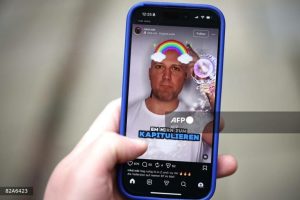
An AFP investigation has found that far-right German-language rappers are increasingly using popular social media platforms like TikTok to spread extremist rhetoric, antisemitism, and disinformation, successfully bypassing hate speech rules.
Worse still, researchers warn that these public-facing accounts are being used as a gateway to funnel potential recruits into more private, less-restricted platforms like WhatsApp and Discord.
Case Study: The “Old Painter” and Antisemitic Tropes
One prominent example is a rapper named “MaKss Damage” (real name Julian Fritsch), who has been identified by Germany’s federal domestic intelligence agency as a right-wing extremist.
In one video, Fritsch rapped about the war in Gaza, suggesting Adolf Hitler was right to warn about the destruction caused by Jews. As he rapped, his face morphed into an antisemitic demonic caricature.
“Back then it was Germany, today it’s Palestine,” Fritsch rapped, adding: “This time, people are questioning… They listen to old painters talk and understand history.”
The reference to Hitler, who aspired to be an artist, was unambiguous. In the same song, Fritsch promoted an unfounded antisemitic conspiracy theory about the September 11, 2001, attacks.
While TikTok removed the rapper’s accounts after being contacted by AFP, the incident highlights a growing problem.
The Far-Right’s “Pro-Palestinian Twist”
The investigation notes a strange contradiction in the extremist messaging. At home, the far-right, including Germany’s surging Alternative for Germany (AfD) party, builds support by agitating against immigration and “Islamisation.”
However, experts point out that when it comes to foreign policy, they often “harbour quite the opposite sympathies, especially toward Palestinians.”
Bernhard Weidinger, an Austrian expert on right-wing extremism, told AFP these groups believe Palestinians are “also kept down by Jews and Americans.”
This dual messaging allows them to attack Germany’s immigration policies while simultaneously using the Gaza conflict to spread antisemitic narratives.
Another rapper, “E.Mar,” who has over 96,000 monthly listens on Spotify, focuses on the anti-immigration angle, rapping: “We are ready for war here: current politics makes you feel foreign in your own country.”
From Public TikToks to Private Chats
German researchers say these neo-Nazi networks flock to TikTok specifically for its “live” video function, which allows real-time interaction with viewers.
Markus Boesch, a researcher at the University of Muenster, described these livestreams as a “more private, intimate situation” that “might turn into some form of extremist recruitment.”
From there, users are encouraged to join related groups on Telegram or Discord—platforms that typically have far fewer content restrictions.
Evading Bans in a Game of “Whack-a-Mole”
These extremist communities are described as “not massive, but nimble,” often migrating between new accounts once they are blocked.
They employ tactics to avoid detection, including:
- Regularly rescheduling livestreams.
- Promoting backup accounts in advance.
- Using coded emojis to signify allegiance, such as a blue heart for AfD support or two lightning bolts (a reference to the Nazi SS unit).
Platform responses remain a step behind. Spotify told AFP it removes songs promoting violent extremism, but content may remain if it “does not explicitly incite violence or hatred.” As an example, copies of Kanye West’s song “Heil Hitler” can still be found on the platform despite an initial takedown.
This online radicalization is happening as Germany sees a real-world jump in politically motivated crime, including a sharp rise in antisemitic offenses. According to musicologist Thorsten Hindrichs, the entire online neo-Nazi movement has become “significantly more radical in recent years.”
Share On:
CLICK HERE TO PROMOTE YOUR MUSIC/VIDEO